
Circle renews Coinbase deal creating two ways to challenge Coinbase’s USDC payouts, but neither works quickly
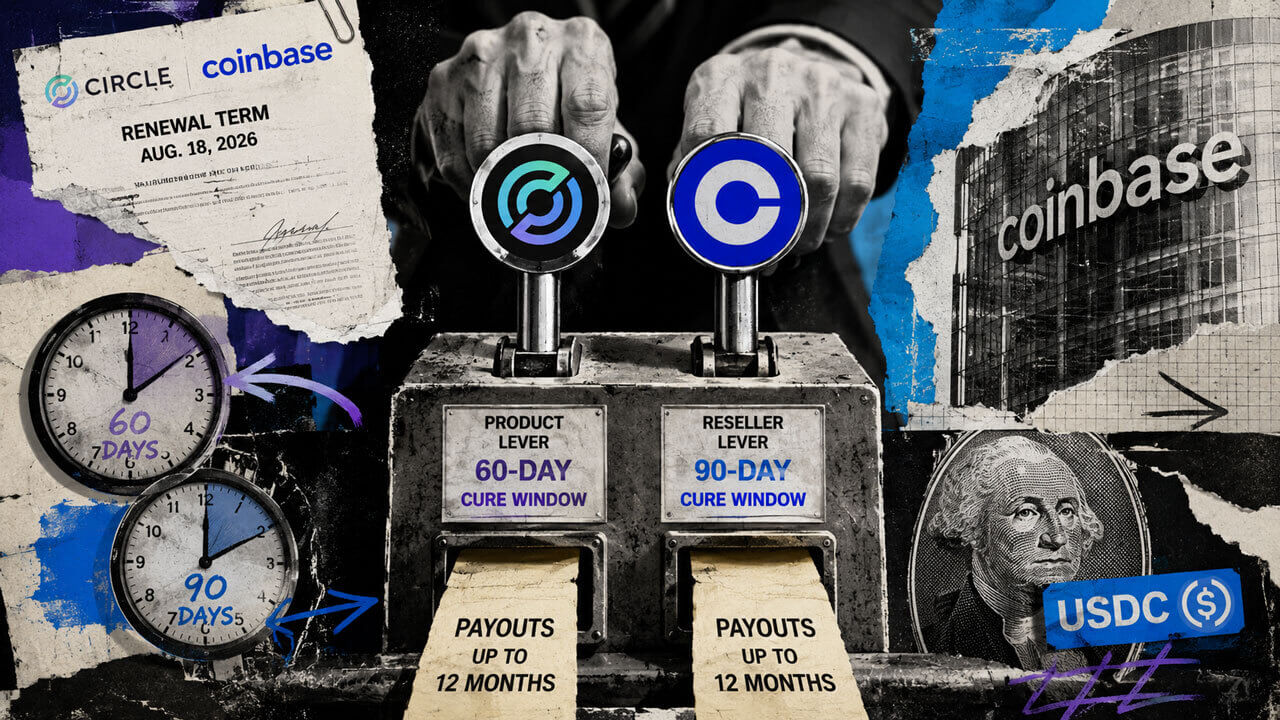


Circle’s renewed agreement with Coinbase preserves the existing economics around USDC for another three-year term and, starting Aug. 18, made two notice-and-cure remedies available if Coinbase misses defined support thresholds.
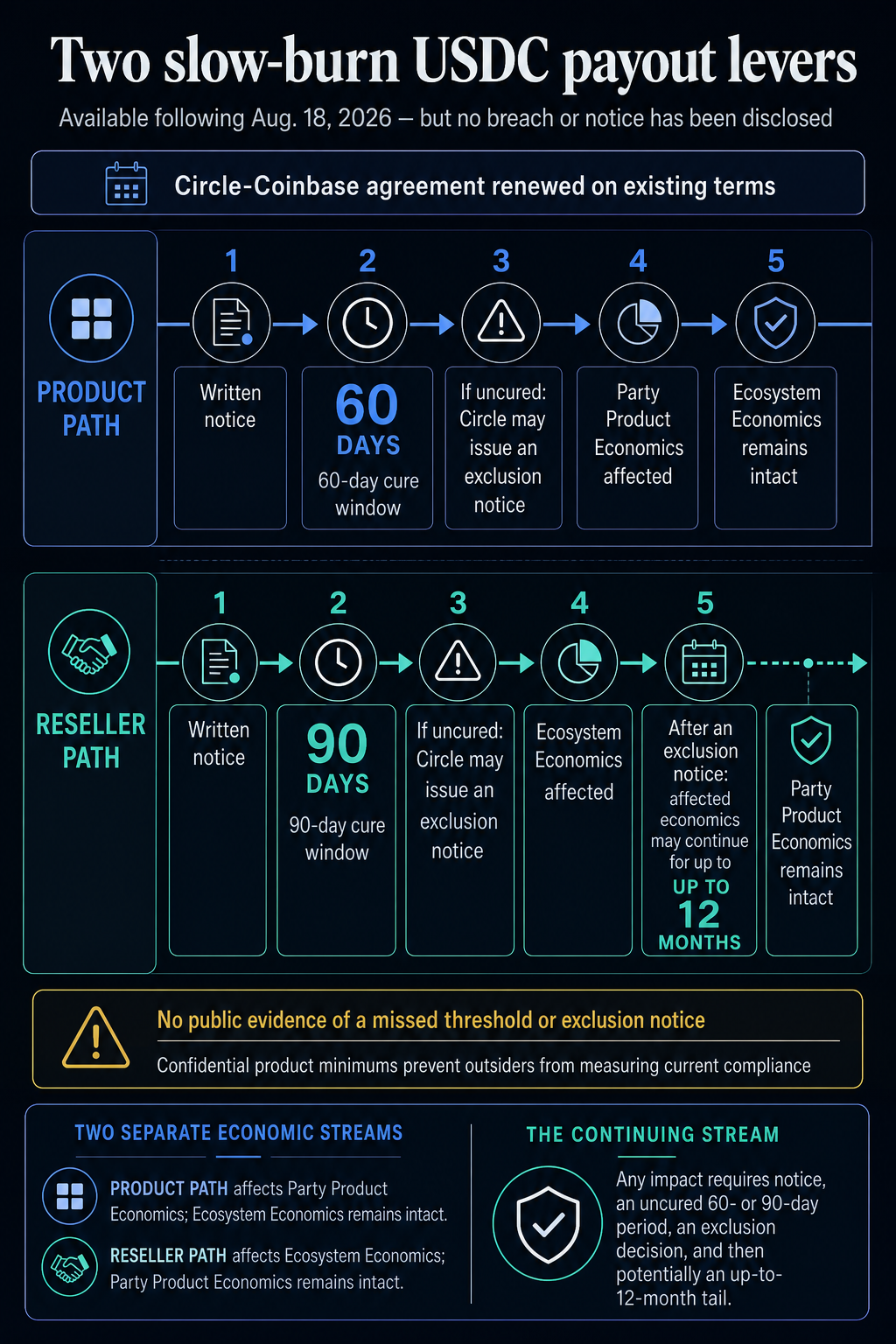
The filed agreement gives Circle leverage over separate parts of Coinbase’s payout, but it operates in stages. A product-support failure carries a 60-day cure window. A reseller failure carries a 90-day window. Circle must then issue an exclusion notice, and Coinbase can remain entitled to the affected payment stream for up to another 12 months.
Neither company has publicly disclosed a missed threshold or exclusion notice. The change is therefore in the balance of contractual leverage, rather than Coinbase’s current payments.
Circle CEO Jeremy Allaire said during the company’s Aug. 5 earnings call that the Coinbase agreement had renewed on its existing terms. The original agreement, dated Aug. 18, 2023, set an initial three-year term and provided for additional three-year renewal terms. Its product and reseller remedies apply during a renewal term, while an attached license schedule makes Circle’s rights available following Aug. 18, 2026.
The agreement separates two payout levers
The contract treats Party Product Economics and Ecosystem Economics as distinct streams. Each remedy has its own threshold and timing, and excluding one stream leaves the other intact.
Contract leverThreshold at issuePre-exclusion cure windowEconomics Circle may excludeEconomics left intactProduct ThresholdUSDC support across chains or Layer 2 networks, products or services, and product discoverability60 days after noticeParty Product Economics AmountEcosystem Economics AmountReseller ThresholdGenerally, the ability for users to buy and sell USDC for dollars on a platform in the relevant jurisdiction90 days after noticeEcosystem Economics AmountParty Product Economics Amount
For the product path, Circle can issue an exclusion notice if Coinbase fails the Product Threshold and does not cure within 60 days after receiving written notice. The contract also provides a repeated-failure trigger when Coinbase misses the threshold more than three times in a rolling 12-month period, provided each failure was noticed and carried a cure opportunity.
The filing describes the Product Threshold as support across a minimum number of chains or Layer 2 networks, a minimum number of products or services, and product discoverability. It redacts the numerical chain and product minimums, leaving outsiders unable to measure Coinbase’s current compliance with those tests.
The reseller path targets a different obligation and payout stream. An uncured Reseller Threshold failure carries a 90-day period after written notice before Circle can issue the corresponding exclusion notice. For USDC, the visible requirement generally concerns giving users a way to buy and sell the stablecoin for dollars on at least one platform in the relevant jurisdiction.
A Product Threshold exclusion affects Party Product Economics while preserving Ecosystem Economics. A Reseller Threshold exclusion does the reverse. Circle gains a way to pressure a specific stream without ending the full underlying commercial arrangement.
The cure window is only the first clock
The 60-day and 90-day periods mark cure deadlines, while the payout consequence comes later. Once the relevant window closes, Circle must elect to send an exclusion notice for that stream. Coinbase then remains entitled to the affected economics for the lesser of 12 months or a shorter period tied to the timing of a prior re-entry.
A first-time example illustrates how gradual the process can be. If Circle sends a product exclusion notice as soon as an uncured 60-day window closes and the full payment tail applies, the affected stream could continue for roughly 14 months from the initial notice. The comparable reseller path could stretch to roughly 15 months after adding the 90-day cure window. These illustrations assume no cure, an immediate exclusion decision after the window and the maximum tail. They do not indicate that either process has started.
The agreement adds another, separate clock after exclusion. Coinbase has a five-year cumulative period to re-satisfy the relevant threshold and send a valid re-entry notice, after which the affected economics resume prospectively. Time used before a re-entry reduces the cumulative period available following later exclusions.
These protections make Coinbase’s payout harder to switch off than the Aug. 18 date alone suggests. Circle can place a defined stream at risk, but the contract builds in a chance to cure, a post-exclusion payment tail and a path back into the economics.
The scale of Coinbase’s role makes that leverage financially meaningful. Coinbase reported that average USDC held in its products reached $20 billion during the second quarter. It separately said its quarter-end holdings exceeded 30% of all USDC in circulation. Circle reported total circulation of $73.3 billion at June 30.
Coinbase’s $20 billion figure is a quarterly average, while its greater-than-30% share and Circle’s $73.3 billion total are point-in-time figures at quarter end. They show Coinbase’s distribution weight without forming one numerator-and-denominator calculation.
The renewed deal removes the immediate renegotiation cliff while giving Circle a bounded enforcement process that did not apply during the initial term. Circle can now begin a 60- or 90-day path if a relevant threshold is missed, but any effect on Coinbase’s payout would still require a notice, an uncured failure, an exclusion decision and the applicable payment tail.


